

Standing out in the fast-changing event industry often feels challenging for aspiring professionals across India. Breaking away from outdated planning methods, more young event managers now embrace design thinking to create bold, user-centered experiences. By focusing on empathy, iteration, and collaboration, this approach offers practical tools for solving complex event challenges and advancing your career through truly innovative solutions.
Table of Contents
- Understanding Design Thinking Principles In Business
- Key Phases Of The Design Thinking Process
- Applications In Event Management And Media
- Essential Skills For Effective Implementation
- Challenges And Mistakes To Avoid In Practice
Key Takeaways
| Point | Details |
|---|---|
| Design Thinking Enhances Innovation | By focusing on user insights and collaborative approaches, organisations can develop disruptive solutions. |
| Iterative Process is Key | The non-linear structure of design thinking allows for flexibility and continuous refinement of ideas based on user feedback. |
| Empathy is Essential | Deep understanding of user experiences ensures that solutions are relevant and effective in addressing real needs. |
| Common Pitfalls Exist | Awareness of superficial insights and organisational resistance can help mitigate challenges in implementing design thinking. |
Understanding Design Thinking Principles in Business
Design Thinking represents a transformative problem-solving methodology that reimagines how organisations approach complex challenges. At its core, this strategic approach provides businesses with a systematic framework for driving innovation by understanding human-centred problem-solving through empathy, creativity, and iterative development.
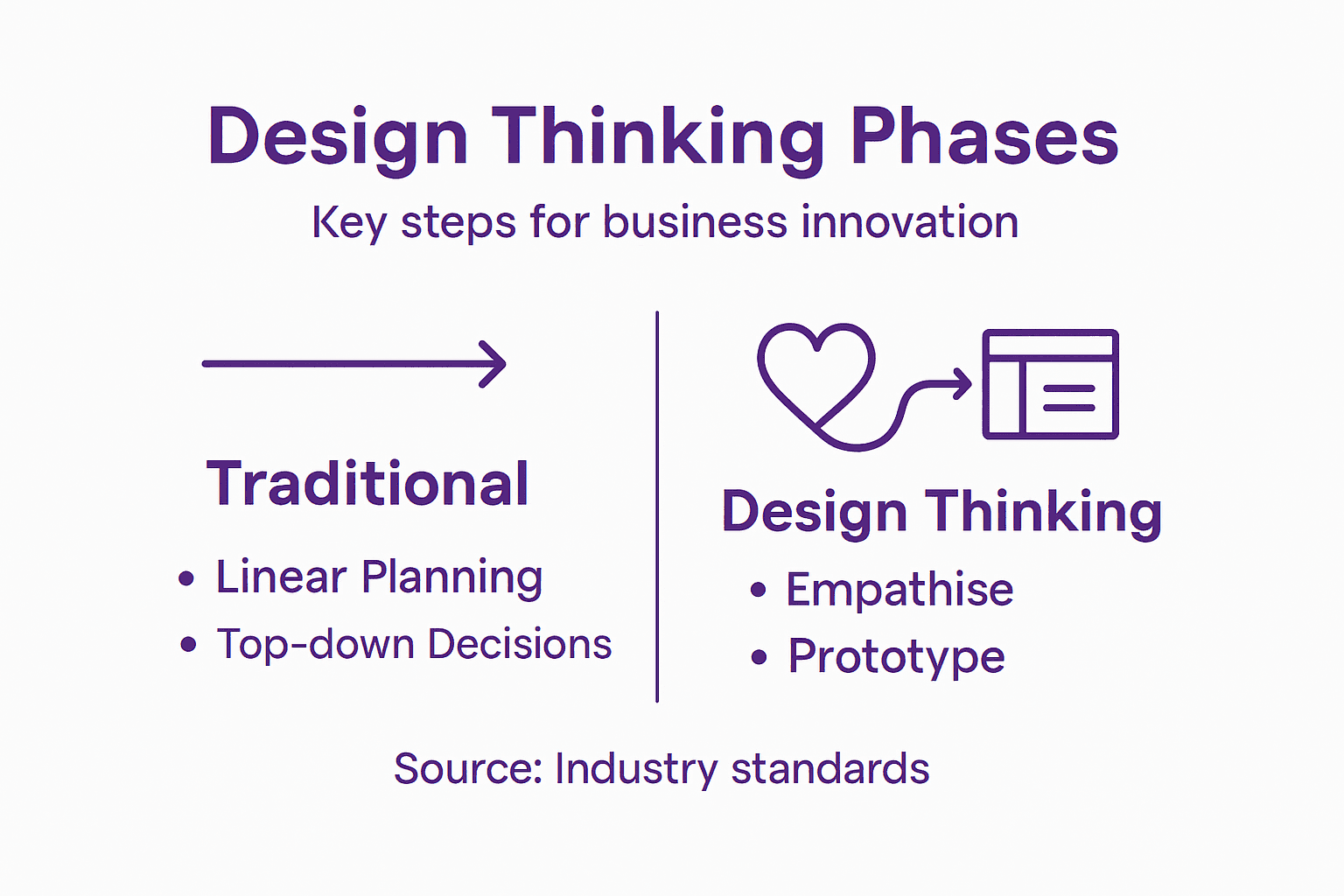
The methodology fundamentally differs from traditional linear problem-solving techniques by emphasising collaborative and experimental processes. Sustainable transformation strategies emerge from its key principles, which include:
- Empathy: Deeply understanding user needs and experiences
- Iteration: Continuously refining solutions through rapid prototyping
- User-Centredness: Placing human experiences at the centre of design
- Systems Thinking: Recognising interconnected complexity in organisational challenges
Successful implementation requires multidisciplinary teams that can blend cognitive insights with practical engineering approaches. This involves breaking down traditional organisational silos and creating environments where diverse perspectives can genuinely collaborate. By integrating abductive reasoning – which allows for creative hypothesis generation – businesses can tackle what researchers term “wicked problems” that resist conventional analytical methods.
Here is a summary of how design thinking principles transform business approaches:
| Principle | Traditional Approach | Design Thinking Approach |
|---|---|---|
| Problem Framing | Focus on efficiency | Focus on user insights |
| Team Composition | Siloed, specialised roles | Multidisciplinary, collaborative |
| Process Structure | Sequential, linear steps | Iterative and adaptive |
| Innovation Outcome | Incremental improvements | Disruptive, user-driven solutions |
Pro tip: Start small by introducing design thinking principles in a single project team, documenting learnings and gradually expanding the approach across your organisation.
Key Phases of the Design Thinking Process
Design Thinking is a dynamic, non-linear problem-solving approach that guides organisations through systematic innovation stages. Unlike traditional linear methodologies, this process allows teams to move flexibly between different phases, ensuring a comprehensive and adaptable approach to complex challenges.
The process typically encompasses five interconnected stages that organisations can navigate strategically:
Empathise: Immersing deeply in user experiences
- Conducting user research
- Gathering qualitative insights
- Understanding emotional and practical needs
Define: Synthesising research into clear problem statements
- Analysing collected user data
- Identifying core challenges
- Creating precise user personas
Ideate: Generating diverse potential solutions
- Conducting brainstorming sessions
- Encouraging creative thinking
- Exploring multiple problem-solving approaches
Prototype: Developing tangible solution representations
- Creating low-fidelity models
- Experimenting with different solution configurations
- Building quick, cost-effective prototypes
Test: Evaluating solutions with target users
- Gathering user feedback
- Refining prototypes iteratively
- Incorporating user insights
These contextual innovation stages are not strictly sequential but represent an adaptive framework where teams can move back and forth, continuously learning and improving their approach. The flexibility allows organisations to respond dynamically to emerging insights and changing user needs.

Pro tip: Document your design thinking journey meticulously, tracking how you navigate between different phases and capturing learnings that can inform future innovation processes.
Applications in Event Management and Media
Design Thinking has emerged as a transformative approach in both event management and media industries, offering innovative strategies for creating more engaging and user-centric experiences. Academic conference design research demonstrates how systematic user journey mapping and stakeholder feedback can revolutionise event planning and execution.
In event management, design thinking enables professionals to:
- Understand attendee expectations through deep empathy
- Create more personalised event experiences
- Develop flexible and adaptive event frameworks
- Anticipate and resolve potential participant challenges
Media management similarly benefits from this approach, with cross-disciplinary innovation strategies that emphasise creative problem-solving and user-centred product development. The methodology allows media professionals to:
- Explore complex communication challenges
- Develop more responsive media products
- Integrate user feedback into continuous improvement cycles
- Break down traditional departmental silos
Practical application involves conducting immersive research, creating personas, prototyping event experiences, and continuously refining solutions based on real-world insights. This approach transforms traditional event and media planning from a linear process to a dynamic, iterative journey of discovery and innovation.
Pro tip: Conduct regular user feedback sessions and prototype multiple event scenarios to identify unexpected insights and opportunities for enhancement.
Essential Skills for Effective Implementation
Design Thinking demands a sophisticated set of skills that go beyond traditional problem-solving approaches. Innovative problem-solving capabilities are crucial for organisations seeking to transform complex challenges into meaningful solutions through systematic and creative methodologies.
Key skills essential for effective design thinking implementation include:
Empathy and User Understanding
- Deep listening techniques
- Observational research skills
- Ability to suspend personal judgments
- Genuine curiosity about user experiences
Creative Problem Framing
- Identifying underlying systemic challenges
- Reframing problems from multiple perspectives
- Breaking traditional thinking patterns
- Generating innovative solution frameworks
Collaborative Capabilities
- Cross-functional communication skills
- Active participation in multidisciplinary teams
- Openness to diverse perspectives
- Constructive feedback mechanisms
Iterative Thinking
- Comfort with experimentation
- Rapid prototyping skills
- Continuous learning mindset
- Resilience in face of initial failures
Successful implementation requires interdisciplinary collaboration and reflective practices that encourage teams to challenge existing assumptions and develop innovative approaches to complex organisational challenges.
Pro tip: Create a personal skill development portfolio documenting your design thinking journey, tracking experiments, learnings, and breakthrough moments to demonstrate continuous professional growth.
Challenges and Mistakes to Avoid in Practice
Design Thinking, while powerful, is not without its potential pitfalls. Organisational innovation challenges can significantly undermine the effectiveness of this approach if teams do not remain vigilant and intentional in their implementation.
Common mistakes that can derail design thinking initiatives include:
Superficial User Understanding
- Conducting shallow or insufficient research
- Relying on assumptions instead of genuine insights
- Failing to engage deeply with user experiences
- Neglecting diverse user perspectives
Procedural Misunderstandings
- Treating design thinking as a rigid checklist
- Rushing through iterative stages
- Ignoring the underlying philosophical approach
- Implementing tools without embracing the mindset
Organisational Resistance
- Lack of leadership support
- Rigid hierarchical structures
- Fear of experimentation
- Punitive cultures that discourage failure
Team Dynamics Issues
- Insufficient team diversity
- Poor cross-functional communication
- Dominant personalities overshadowing collaborative processes
- Limited psychological safety for sharing ideas
Understanding design thinking implementation pitfalls requires recognising that this approach is fundamentally about cultivating a holistic, user-centric mindset rather than simply applying a set of prescribed techniques.
This table contrasts key challenges in design thinking with effective mitigation strategies:
| Common Challenge | Impact on Process | Recommended Mitigation |
|---|---|---|
| Superficial user insight | Solutions miss real user needs | Deep qualitative research |
| Organisational resistance | Slow adoption and low engagement | Leadership buy-in and pilot projects |
| Rigid team dynamics | Stifled creativity and weak outcomes | Foster open communication, diverse teams |
| Misapplied methodologies | Reduced impact or wasted resources | Ongoing education and reflective review |
Pro tip: Create a reflective practice journal to document your design thinking journey, capturing not just successes but meaningful learning moments from potential failures.
Transform Your Innovation Journey with Expert Event Management Training
Design Thinking in business requires deep empathy, creative problem framing and collaborative teamwork to truly drive user-centred innovation. If you are passionate about mastering these principles to revolutionise event management projects and create engaging, adaptable experiences you will benefit from specialised training rooted in real industry practices. At teami.org, we provide comprehensive courses that blend theory with hands-on projects, internships and real event exposure to build your skills in empathy-driven design thinking and iterative innovation.
Take a decisive step towards transforming complex challenges into disruptive event solutions with our accredited certification programmes. Explore how your creative potential can thrive through multidisciplinary collaboration and reflective practices that echo the key skills highlighted in the latest industry research. Discover course options, detailed offerings and career benefits now by visiting teami.org. Start your journey with direct personalised support and learn how to apply design thinking principles effectively in your career today.
Frequently Asked Questions
What are the key principles of Design Thinking in business?
Design Thinking is based on several key principles including empathy, iteration, user-centredness, and systems thinking. These principles emphasise understanding user needs, refining solutions through prototyping, and recognising the interconnected complexities of organisational challenges.
How can Design Thinking improve innovation in organisations?
Design Thinking fosters innovation by providing a systematic framework that encourages collaboration, experimentation, and creative problem-solving. It allows teams to focus on user insights, leading to more relevant and disruptive solutions that align with real-world needs.
What are the main phases of the Design Thinking process?
The Design Thinking process comprises five main phases: Empathise, Define, Ideate, Prototype, and Test. These phases are not strictly sequential, allowing teams to move flexibly between them to refine solutions based on user feedback and insights.
What skills are essential for effective Design Thinking implementation?
Essential skills for implementing Design Thinking effectively include empathy and user understanding, creative problem framing, collaborative capabilities, and an iterative thinking mindset. These skills help teams navigate complex challenges and uncover meaningful solutions.
Recommended
- Event Design Concepts: Key Ideas for Modern Event Success – team I
- How Many Clients You Will Have After This Health Crisis Goes Away? – team I
- Life is a Son of a Pitch – team I
- Creative Event Ideas for Aspiring Event Managers – team I
- Transformation digitale interne | Yelido
Thinking about a career in event management?
team I is Bangalore’s only EEMA-certified event management institute, running for 24 years, where students work on real live events with real budgets and real deadlines rather than classroom simulations. See the full range of event management courses in Bangalore, or go straight to the flagship Certificate Program in Event Management (CPEM).