
The event planning industry is defined as the professional coordination of all logistical, creative, and operational elements required to deliver a successful event. From a 2,000-guest wedding in Jaipur to a corporate product launch in Hyderabad’s HICC, this industry touches every city, every budget, and every ambition. India’s event sector is one of the fastest-growing in Asia, with urban centres like Bangalore, Mumbai, Delhi, and Hyderabad driving demand for skilled event management professionals year on year. If you are exploring a career in this field, or simply trying to understand how it works, this guide gives you the real picture.
What are the main sectors in the event planning industry?
The industry splits into four broad sectors, each with its own rhythm, budget scale, and skill demands.
| Sector | Typical scale | Lead time | Core skills |
|---|---|---|---|
| Social events (weddings, birthdays) | 50–2,000 guests | 3–12 months | Vendor negotiation, décor, family liaison |
| Corporate events | 20–5,000 attendees | 6–12 months | Logistics, AV production, ROI reporting |
| Entertainment (concerts, festivals) | 500–100,000+ | 6–18 months | Crowd flow, ticketing, artist management |
| Conferences and summits | 100–10,000 | 4–12 months | Content programming, sponsorship, tech |
The wedding planning industry alone generates enormous economic activity across India. A single large wedding in Mumbai or Delhi can involve 50-plus vendors, multiple venues, and a production budget that rivals a mid-size corporate conference. Corporate event planning, by contrast, demands a sharper focus on measurable business outcomes rather than visual spectacle.

Specialisations within each sector include venue management, logistics, experience design, production, and sponsorship activation. Knowing which specialisation suits your strengths is the first real career decision you will make. Teami’s programmes are structured around these exact pathways, so students choose their lane early and build depth fast.
What are the current event planning trends shaping 2026?
The numbers tell a clear story. 95% of event organisers anticipate increased use of AI in their planning processes in 2026. That figure signals a profession in rapid transition, not a slow evolution.
The most significant trends reshaping the field right now are:
- AI-assisted planning: Tools that automate run-of-show scheduling, attendee data analysis, and vendor communication are becoming standard. Read more on AI in event management to understand where the technology is heading.
- Experience architecture: Success is now defined by clear business intent and emotional audience journeys, not by stage size or floral budgets.
- Data-driven ROI: Only 40% of planners now struggle to prove event ROI, down from 70% in 2025. Better measurement tools are closing that gap fast.
- Hybrid and phygital formats: India’s diverse geography makes hybrid events commercially essential. A conference anchored in Bangalore can simultaneously engage audiences in Tier 2 cities like Coimbatore or Nagpur.
- Cultural specificity: Indian audiences expect events that reflect regional identity. A corporate gala in Chennai carries different cultural expectations than one in Chandigarh.
Event planners today must combine data literacy with creative instinct. The planner who only knows how to decorate a stage is being replaced by the planner who can read an attendee satisfaction dashboard and redesign the programme accordingly.
Pro Tip: When adopting AI tools, always layer in local cultural knowledge. An algorithm can schedule a breakout session, but it cannot tell you that a Friday afternoon slot will empty out in Mumbai during Ganesh Chaturthi week.
How do event planners manage full event lifecycles in India?
Planning an event in India is not a linear process. It is controlled chaos with a very specific structure underneath. Here is how experienced planners actually work through it.
- Define the strategic “why.” Venue selection comes second. Choosing a venue before defining your event’s purpose constrains every decision that follows and often destroys ROI before the first rupee is spent.
- Build a category budget. The recommended allocation framework is: 30–40% venue, 20–25% catering, 10–15% AV and production, 15–20% travel and accommodation, and 10–15% contingency. That contingency is not optional. In India, last-minute vendor cancellations and weather disruptions are routine.
- Lock vendors with written contracts early. For corporate events, a planning timeline of 6–12 months is the professional standard. Shorter timelines reduce your vendor options and raise costs significantly.
- Build the run-of-show document. This is the minute-by-minute blueprint that governs every vendor, technician, and staff member on event day. Experienced planners treat its absence as a guarantee of operational failure. No run-of-show means no control.
- Conduct a risk assessment. Power failures, monsoon rain, and traffic gridlock are not edge cases in Indian cities. They are planning variables. Use a structured event risk assessment process to anticipate and document every plausible disruption.
- Execute post-event follow-up. Collect attendee feedback, reconcile the budget against actuals, and document what broke. That debrief is where your next event gets better.
Pro Tip: In Hyderabad and Mumbai, always build a 45-minute buffer into your run-of-show for VIP arrivals. Dignitaries and senior executives rarely arrive on schedule, and your entire programme will cascade if you have not planned for it.
What career opportunities exist in the event planning industry?
The roles available in event management services span a wide spectrum, from entry-level coordination to senior production leadership.
- Event coordinator: Manages logistics, vendor communication, and on-ground execution. This is the standard entry point.
- Event manager: Oversees the full project lifecycle, client relationships, and team leadership.
- Event producer: Controls the creative and technical production elements, from stage design to lighting rigs.
- Specialist roles: Wedding planner, sports event manager, conference producer, and experiential marketing lead are all distinct career tracks.
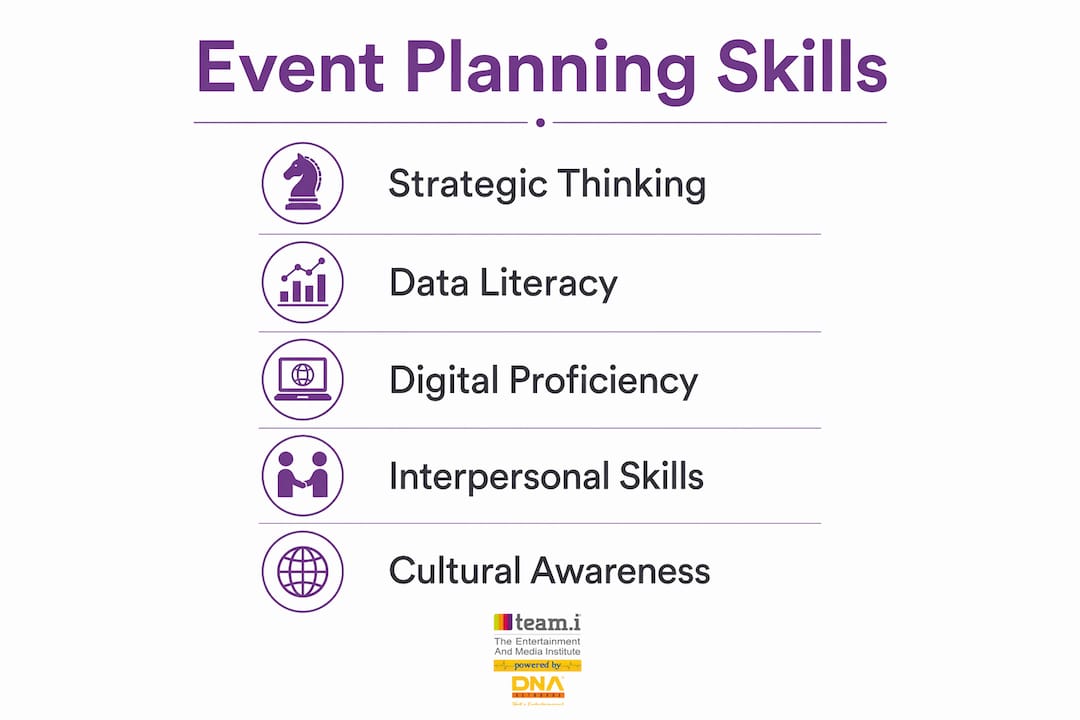
The skills that matter most in 2026 go well beyond organisation. Strategic thinking and data literacy are now baseline requirements for mid-level roles. Digital literacy, specifically the ability to use event tech platforms, analyse attendee data, and manage hybrid production, separates average planners from the ones clients call back.
Certifications accelerate career entry in India. Cities like Bangalore and Delhi have active event industry networks, and a recognised certification opens doors that a CV alone cannot. Internships are equally critical. Working a real event, even in a junior capacity, teaches crowd flow logistics, vendor pressure, and client management in ways that no classroom can replicate.
Teami’s 24 years of industry experience and its partnership with DNA Entertainment Networks give students direct access to live productions, internships, and placement networks across India. You do not graduate and then look for experience. You build it while you study.
Explore creative event ideas to understand the kind of thinking that separates good event managers from great ones.
What I have learnt from watching this industry evolve
The event planning profession in India has changed more in the last three years than in the previous decade. Clients are sharper, budgets are scrutinised harder, and the bar for what counts as a “successful” event has risen dramatically.
The planners who are thriving are not the ones with the most creative ideas. They are the ones who can walk into a client brief, identify the business objective underneath the brief, and design an experience that delivers against it. Creativity without strategic alignment is just expensive decoration.
Adaptability is not a soft skill in this industry. It is the core competency. The planner who cannot pivot when a keynote speaker cancels at 6 PM, or when the AV rig fails during a product launch in Bangalore, does not last long. The ones who do last are the ones who have rehearsed failure and built contingencies for it.
This career is genuinely rewarding. A well-executed event changes how an audience feels about a brand, a cause, or a moment in their lives. That impact is real and measurable. But it demands rigour, not just passion.
— Teami
Teami’s event management courses: where careers begin
Teami offers structured event management courses built around the realities of the Indian event industry, not a generic international curriculum. With 24 years of experience, accredited programmes, and direct industry partnerships through DNA Entertainment Networks, Teami prepares students for the roles that actually exist in the market. Courses cover corporate event planning, wedding management, sports events, and entertainment production, with hands-on projects and real event participation built into every programme. Both online and hybrid options are available, so geography is not a barrier. If you are serious about a career in event management services, this is where that career takes shape.
FAQ
What is the event planning industry?
The event planning industry is the professional sector responsible for organising, managing, and executing events ranging from weddings and corporate conferences to concerts and festivals. It encompasses logistics, production, vendor management, and experience design.
How long does it take to plan a corporate event?
A planning timeline of 6–12 months is the professional standard for corporate events. Shorter timelines reduce vendor choice and increase costs significantly.
What skills do event planners need in 2026?
Event planners need strategic thinking, data literacy, digital platform proficiency, and strong interpersonal skills. Content quality is the top driver of attendee satisfaction, so creative and analytical abilities must work together.
Is certification necessary for a career in event management?
Certification is not legally required, but it significantly accelerates career entry and credibility in India’s competitive event market. Recognised certifications open professional networks and client opportunities that a CV alone cannot access.
How is AI changing event planning?
95% of event organisers anticipate increased AI use in 2026. AI tools handle scheduling, attendee data analysis, and vendor communication, but human planners remain essential for cultural judgement and real-time problem-solving.