
Event planning networking events are structured gatherings designed to generate a high volume of valuable professional introductions in a short, focused timeframe. Unlike casual social mixers, these are engineered for efficiency. Well-executed networking mixers generate 15–20 meaningful introductions per attendee, far exceeding what unstructured settings ever produce. That number tells you everything. Design, format, and technology are not optional extras. They are the difference between a room full of strangers and a room full of future collaborators. Whether you are organising a corporate summit in Bangalore or a wedding industry mixer in Mumbai, the principles are the same.
What are the main formats used in event planning networking events?
The format you choose shapes the quality and quantity of every introduction made. Get it wrong and you get a room full of people staring at their phones. Get it right and you get controlled, productive energy that attendees talk about for months.
| Format | Group size | Duration | Primary goal |
|---|---|---|---|
| Industry mixer | 30–150 | 2–3 hours | Broad introductions |
| Executive roundtable | 8–20 | 90 minutes | Peer-level dialogue |
| Speed networking | 20–80 | 60 minutes | High-volume connections |
| Themed discussion tables | 15–60 | 2 hours | Topic-focused exchange |
| Pre-conference networking | 50–300 | 45–90 minutes | Warm-up before main event |

The most underrated format in India right now is speed networking. A 60-minute speed networking session can produce more introductions than a year of typical, unstructured networking. That is not a motivational quote. That is a structural reality. When you give people two minutes, a clear prompt, and a bell, they stop overthinking and start talking.
Themed discussion tables work brilliantly for corporate networking gatherings in cities like Hyderabad and Delhi, where professionals often arrive with a specific agenda. Grouping attendees by sector, challenge, or interest level removes the awkward “so what do you do?” opener and replaces it with a real conversation already in progress.
How should you schedule and prepare networking events for success?
Timing is where most event coordinators lose the plot. They book the venue, send the invites, and hope the rest falls into place. It does not.
- Define your participant profile first. Know exactly who you want in the room before you book anything. A curated guest list of 60 relevant professionals beats a generic crowd of 200 every time.
- Book the venue early. In Bangalore and Mumbai, premium venues with the right layout for networking fill up 8–10 weeks in advance. Do not leave this until the last month.
- Set your lead time by event type. Recurring mixers need 4–6 weeks of planning time. Major conferences and executive roundtables require 3–6 months. Treat these as hard minimums, not targets.
- Build your agenda around energy, not just time. Schedule high-energy formats like speed networking in the first hour, when attendees are fresh. Save open networking for after structured sessions, when people already have conversation threads to continue.
- Send pre-event communication 1–2 weeks out. Share the attendee list, the session format, and any preparation prompts. Attendees who know what to expect arrive ready to engage.
Pro Tip: Always build a 20-minute buffer into your run-of-show for networking events in Indian cities. Traffic in Bangalore and Mumbai is genuinely unpredictable, and late arrivals during a speed networking rotation can disrupt the entire room’s rhythm.
For large-scale event management conferences in India, participant curation is as important as the programme itself. A roundtable of 15 senior professionals who share a real challenge produces more value than a panel of 200 passive listeners.
What role does technology play in networking events in 2026?
Technology does not replace the handshake. It makes the handshake worth more. The most effective networking platforms in 2026 let attendees browse profiles and request one-to-one meetings before the event even begins.
Pre-event profile browsing and scheduled meetings, activated 1–2 weeks ahead of the event, significantly raise the quality of connections made on the day. Attendees arrive with a shortlist of people they genuinely want to meet. That changes the entire energy of the room.
AI matchmaking takes this further. AI matchmaking algorithms let organisers prioritise VIPs, sponsors, and key participants to guarantee high-value introductions happen. This is particularly useful for corporate networking gatherings where sponsors need face time with specific decision-makers. The algorithm does the curation work that would otherwise take a coordinator hour of manual cross-referencing.
The global professional community The Delegate Wranglers has nearly 30,000 members worldwide as of june 2026. That scale reflects how seriously the events industry now takes structured, technology-supported networking. Smaller curated communities focused on real-world experience consistently yield higher quality professional networks than large, open groups. Size is not the goal. Relevance is.
Event organisers integrating networking tech, AI matchmaking, and analytics can tie attendee data directly to measurable business outcomes. That means you can show a sponsor exactly how many qualified introductions their investment produced. In India’s growing corporate events market, that kind of accountability is becoming a baseline expectation, not a premium offering.
For practical guidance on event networking software and how venues can use technology to drive attendee engagement, the principles apply equally to Indian conference centres and boutique hotel ballrooms in Goa or Pune.
What design principles maximise attendee engagement?
The room layout is a networking tool. Most organisers treat it as an afterthought. The best ones treat it as a first draft of the attendee experience.
- Use round tables, not theatre seating. Round tables signal conversation. Rows of chairs signal a lecture. If you want people to talk, design a room that expects them to.
- Place themed signage at each table. Labels like “Tech Founders,” “Wedding Vendors,” or “Corporate AV Specialists” let attendees self-select and arrive at a table with a ready-made context.
- Open with a structured icebreaker. Themed tables and guided icebreakers reduce social friction and encourage interaction from the first minute. A simple prompt like “share one challenge you are solving this quarter” works better than any formal introduction.
- Pace the programme deliberately. Alternate between structured and unstructured time. Give people a task, then give them space to follow up on it.
- Assign a roving facilitator. One person whose only job is to introduce attendees who look lost or stuck. This is standard practice at high-end corporate events in Delhi and Chennai, and it genuinely changes the room’s dynamic.
Pro Tip: Post-event follow-up is where most networking investment is lost. Send a personalised connection summary within 24 hours of the event, listing each attendee’s name and one conversation point. Attendees who receive this are far more likely to act on the connections they made.
Top planners treat networking as a proactive revenue strategy by focusing on offering value rather than simply asking for business. That mindset shift, from “what can I get?” to “what can I give?”, is what separates a forgettable mixer from one that generates real referrals. For young professionals in event management, building this habit early is one of the most career-defining decisions you can make.
What I have learned about networking events in India
After watching hundreds of networking events across Bangalore, Mumbai, and Hyderabad, one pattern stands out clearly. The events that fail are not the ones with the wrong technology or the wrong venue. They are the ones where the organiser confused activity with connection.
India’s networking culture carries a specific nuance that Western event planning frameworks often miss. Relationships here are built on trust before transaction. A speed networking format that works brilliantly in London can feel transactional and cold in a Bangalore boardroom if it is not warmed up correctly. The icebreaker, the facilitator’s tone, and the post-event follow-up carry more cultural weight here than the app you use to match attendees.
Effective event networking depends more on human confidence and trust than on digital logistics alone. Technology is the scaffold. The human interaction is the building. The best event professionals I have seen in India understand this instinctively. They use platforms and AI matchmaking as tools to set up the conversation, then they get out of the way and let the room do its work.
The shift I would encourage every event planner to make is this: stop measuring networking success by attendance numbers. Start measuring it by the number of introductions that led to a follow-up meeting within two weeks. That metric tells you whether your design actually worked.
— Teami
How Teami prepares you to plan and execute networking events
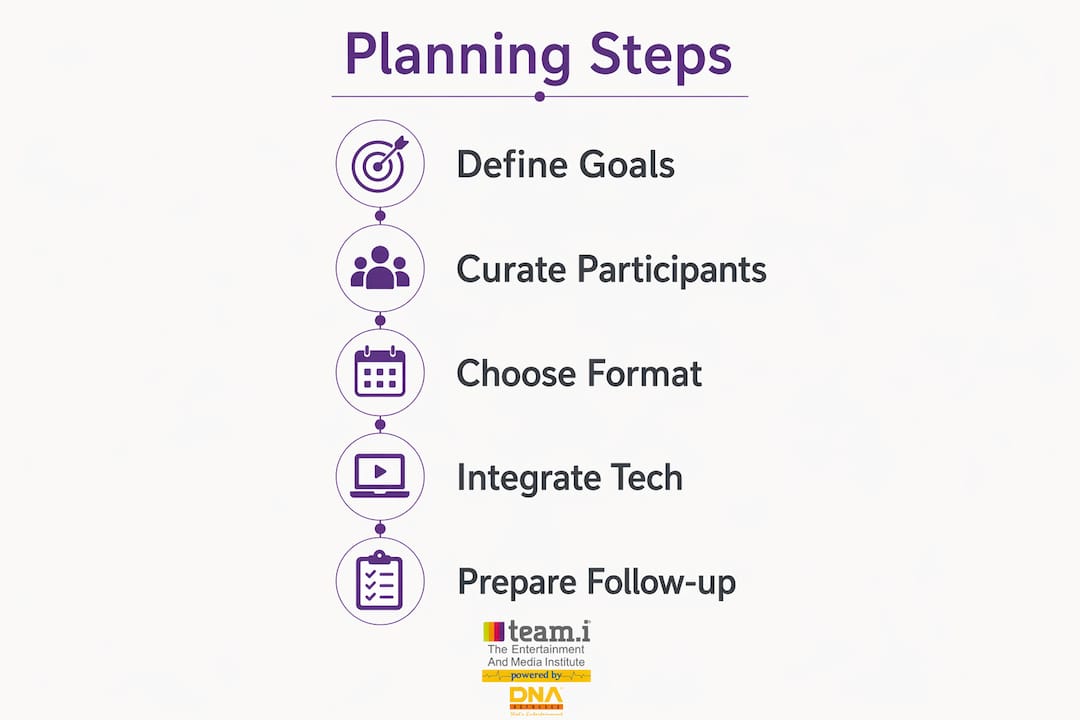
Teami’s event management course covers the full spectrum of networking event planning, from format selection and participant curation to technology integration and post-event analytics. With 24 years of industry experience and a direct partnership with DNA Entertainment Networks, Teami trains you on real events, not simulations. You learn how to read a room, build a run-of-show, and use AI matchmaking tools that Indian corporate clients now expect as standard. If you are serious about building networking skills that translate into a career, Teami’s curriculum is built around exactly that outcome.
FAQ
How many introductions should a well-run networking event produce?
A well-executed networking mixer generates 15–20 meaningful introductions per attendee. Structured formats like speed networking consistently outperform unstructured social settings.
How far in advance should you plan a networking event?
Recurring mixers require 4–6 weeks of lead time. Large conferences and executive roundtables need 3–6 months to allow proper participant curation and venue booking.
What is AI matchmaking in event networking?
AI matchmaking uses algorithms to pair attendees based on shared interests, goals, or professional profiles. Organisers can prioritise VIPs and sponsors to guarantee high-value introductions happen during the event.
What is the most efficient networking event format?
Speed networking is the most efficient format for volume of introductions. A 60-minute session can produce more connections than a year of unstructured networking.
How do you measure the success of a networking event?
Track the number of introductions that resulted in a follow-up meeting within two weeks of the event. Attendance numbers alone do not indicate whether meaningful connections were made.